" " indicates required fields
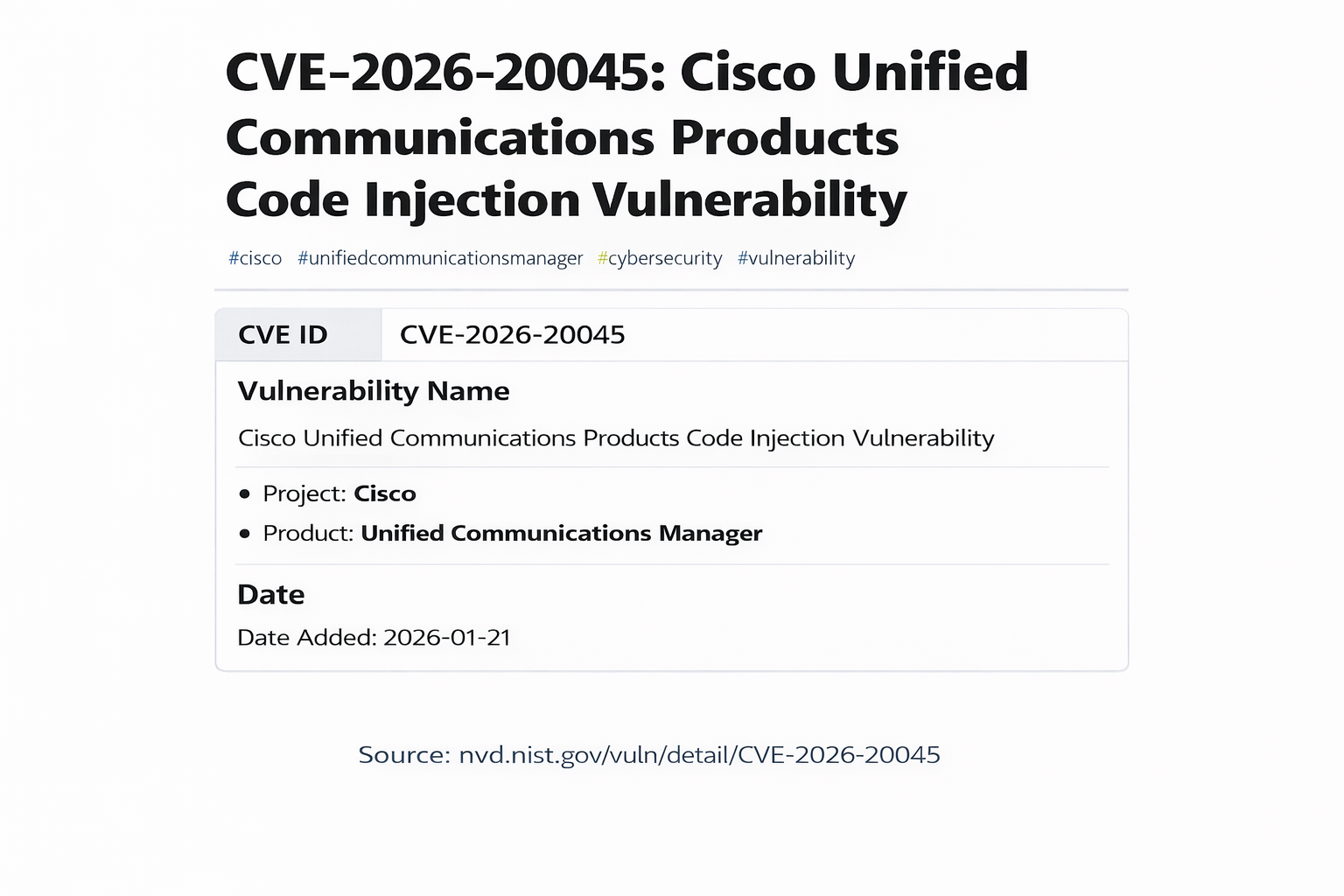
CVE-2026-20045 does not directly affect most devices and products, but its potential impact depends entirely on how affected systems connect to them.
CISA added CVE-2026-20045 to its Known Exploited Vulnerabilities catalog on January 21, 2026. CVE-2026-20045 is a code injection vulnerability (CWE-94) affecting Cisco Unified Communications products. Cisco reports that an attacker could exploit the vulnerability by sending crafted HTTP requests to the web-based management interface of an affected product. Successful exploitation could allow an attacker to obtain user-level access to the underlying operating system and subsequently escalate privileges to root. Cisco assigns this vulnerability a CVSS v3.1 base score of 8.2.
Affected Cisco products include:
Why This CVE Matters in Regulated Environments
This CVE affects perimeter-facing management infrastructure. It does not directly affect vehicles, medical devices, robots, or industrial equipment. That distinction is important. At the same time, perimeter and management infrastructure commonly protects systems that are regulated, safety-adjacent, or operationally critical. As a result, exploitation of such infrastructure can alter the risk profile of dependent systems even when those systems are not themselves vulnerable.
Regulatory Context
Many regulated industries require continuous cybersecurity vulnerability monitoring and documented risk management decisions. Automotive, medical device, industrial, and critical infrastructure programs increasingly require organizations to assess vulnerabilities in the context of system architecture, connectivity, and potential impact rather than relying solely on vulnerability enumeration.
To meet these obligations, organizations must move beyond vulnerability lists and understand the underlying risk mechanics that determine real-world impact.
Key Risk Concepts and Definitions
Transitive Risk
Transitive risk refers to risk that propagates through connected systems due to trust relationships or shared infrastructure.
Lateral Movement Risk
Lateral movement risk refers to the possibility that an attacker who compromises one system can move into other network segments or environments.
Perimeter to OT or Perimeter to IoT Pivot Risk
This refers to the risk of attackers moving from IT-facing infrastructure into operational technology or embedded system environments.
Cascading or Indirect Impact
Cascading impact refers to secondary operational, safety, or regulatory consequences resulting from compromise of supporting infrastructure.
IT and OT Convergence Risk
IT and OT convergence risk arises when enterprise IT systems and operational environments share connectivity, identity, or security controls, increasing exposure.
Application Across Regulated Industries
These risk concepts apply across multiple regulated industries. In automotive environments, perimeter infrastructure often protects OTA backend services, telematics platforms, and fleet systems. In healthcare environments, it protects hospital networks, clinical systems, and network-connected medical devices. In industrial and robotics environments, it protects production networks, remote maintenance access, and connected control systems. In each case, the vulnerability remains the same, but the resulting risk depends on system context.
From Vulnerability Awareness to Contextual Risk
CVE databases and alerts accurately describe affected components and technical severity. They do not explain how a vulnerability alters the exposure of a specific product, system, or regulated environment. Providing that understanding requires knowledge of system architecture, connectivity, trust boundaries, and potential attack paths.
This is the problem space addressed by platforms like C2A Security, which focus on placing vulnerability data into system context so organizations can assess exposure, downstream impact, and regulatory relevance, and prioritize remediation based on actual risk rather than severity scores alone.
Conclusion
Perimeter vulnerabilities will continue to emerge and some will continue to be exploited. For regulated industries, the critical capability is not only detecting vulnerabilities, but translating them into system-level risk understanding. That shift from vulnerability tracking to contextual risk assessment is increasingly expected.
C2A Security uses AI to apply risk context to SBOM and vulnerability data, correlating findings with device architecture and operational use to support defensible remediation decisions. Learn more or request a demo here.





Dynamic threat modeling and risk assessment aligned with global regulations
LLM-agnostic generative AI layer powering automation across every module
Aggregated threat feed contextualized against your actual products
Generate, manage, and triage all BOMs and vulnerabilities across the lifecycle
Quantitative optimization of mitigation strategy and security control allocation
Configurable dashboards and reports across every EVSec data layer
Extract software composition and risk from firmware and binaries without source code
Optimized anomaly detection for Ethernet and CAN, plus ECU runtime protection
Quantify and manage cybersecurity risk for products operating in the field
Enrich SOC events with deep product and architecture context
Context-driven test and validation with intelligent fuzzing, integrated into CI/CD
AI-powered static analysis integrated into CI/CD with reduced false positives
Foundational layer: cyber model, workspaces, and integration backbone to DevOps toolchain
Out-of-the-box and customizable workflows for regulatory and security processes
Centralized compliance management with evidence generated from live data