" " indicates required fields
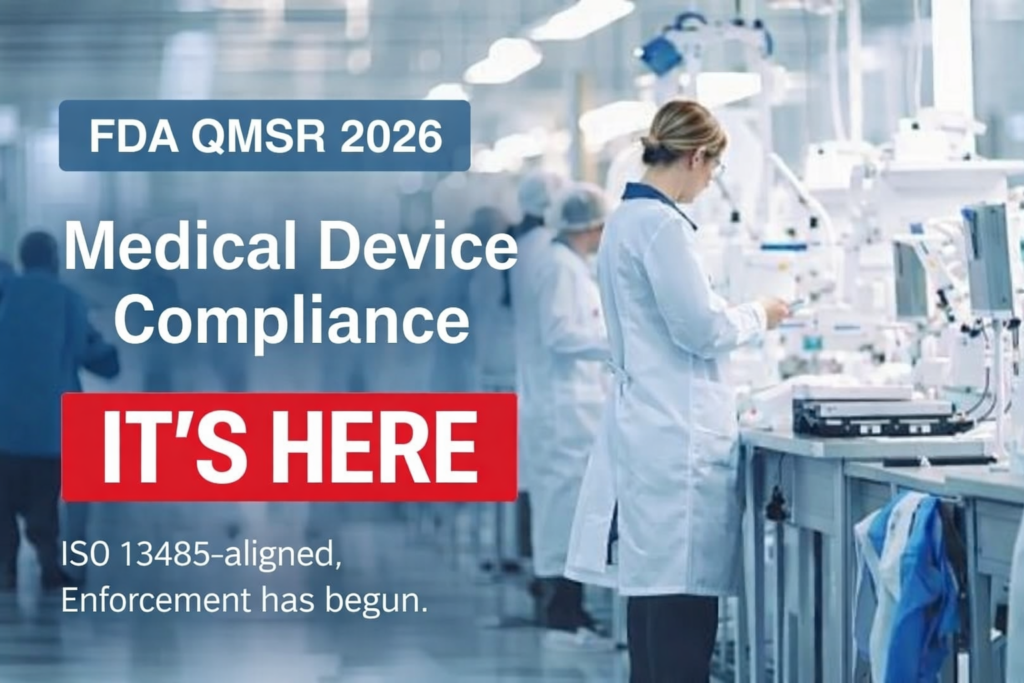
February 2, 2026 marked a watershed moment for the medical device industry. On that date, the FDA’s Quality Management System Regulation (QMSR) formally replaced the long-standing Quality System Regulation (QSR).You can find the ruling here.
On paper, this may look like a technical update. After all, QMSR largely incorporates ISO 13485 by reference. In practice, the shift signals something much deeper: the FDA is moving the industry away from procedural compliance toward data-driven, risk-integrated, and continuously operating quality systems.
If QSR was about proving you had the right procedures, QMSR is about proving that your system actually works under real-world conditions.
The End of Checklist Inspections
Under QSR, many companies became adept at managing inspections through QSIT (Quality System Inspection Technique), essentially a structured checklist. That world is ending. FDA has retired QSIT and has made clear there will be no QSIT 2.0.
What replaces it is more consequential: risk-based, data-driven sampling across your entire QMS. Investigators will no longer just ask, “Do you have a procedure?” They will ask, “Show me how your system behaves when something goes wrong.”
This means inspectors may trace a complaint through CAPA (Corrective and Preventive Action), risk files, MDR (Medical Device Reporting) decisions, design records, and management review, in one continuous thread. Your QMS (Quality Management System) must feel like a living system, not a document repository.
A particularly important change: internal audit reports, supplier audit reports, and management reviews are now fully inspectable.These are no longer “internal safe spaces.” They must be inspection-ready, credible, and consistent with how your organization actually operates.
Complaints Are No Longer Paperwork, They Are Feedback
One of the quieter but most powerful shifts under QMSR is how complaints are treated.
Under ISO 13485, which QMSR incorporates, complaints are not just records, they are formal inputs into risk management and CAPA. Even when a decision is made not to investigate a complaint, the rationale must be clearly documented.
In practice, this means:
A disconnected, siloed quality system will struggle under QMSR. A well-integrated one will shine.
Risk management becomes truly lifecycle-wide
Perhaps the most significant philosophical shift is around risk.
Under QMSR, risk management is no longer a one-time design activity. It must be woven through every stage of the product lifecycle. Risk files are expected to be “living documents,” updated as new data emerge from complaints, adverse events, field performance, and vulnerability disclosures.
Investigators may literally ask:
This raises the bar on traceability. Your ability to quickly show clear links among risk files, design controls, and post-market data will directly influence inspection outcomes.
What QMSR means for manufacturers in practical terms
For most medical device companies, QMSR does not require ripping out existing systems. It does require a shift in mindset and a stronger focus on integration. Manufacturers should expect to:
This is not regulatory theater. QMSR is designed to reduce the gap between paper compliance and real-world safety.
When risk management is truly lifecycle-based and complaints meaningfully inform design and manufacturing decisions, manufacturers are better positioned to prevent issues before they escalate into recalls, safety alerts, or patient harm.
In many ways, QMSR reflects the same lesson seen in recent high-profile cybersecurity recalls: systems fail when processes are reactive, fragmented, and poorly integrated. QMSR pushes the industry toward proactive, integrated, and data-driven quality.
Based on what we know about how FDA intends to inspect under QMSR, manufacturers should prioritize these activities:
QMSR raises the bar on how risk, quality, and post-market data connect across the product lifecycle. Medical device manufacturers that rely on fragmented tools and document-centric processes will feel that pressure first.
C2A Security helps manufacturers operationalize lifecycle risk by connecting complaints, risk management, and post-market cybersecurity into a single, context-based system.
👉 Learn how C2A enables data-driven, inspection-ready quality and product security under QMSR.





Dynamic threat modeling and risk assessment aligned with global regulations
LLM-agnostic generative AI layer powering automation across every module
Aggregated threat feed contextualized against your actual products
Generate, manage, and triage all BOMs and vulnerabilities across the lifecycle
Quantitative optimization of mitigation strategy and security control allocation
Configurable dashboards and reports across every EVSec data layer
Extract software composition and risk from firmware and binaries without source code
Optimized anomaly detection for Ethernet and CAN, plus ECU runtime protection
Quantify and manage cybersecurity risk for products operating in the field
Enrich SOC events with deep product and architecture context
Context-driven test and validation with intelligent fuzzing, integrated into CI/CD
AI-powered static analysis integrated into CI/CD with reduced false positives
Foundational layer: cyber model, workspaces, and integration backbone to DevOps toolchain
Out-of-the-box and customizable workflows for regulatory and security processes
Centralized compliance management with evidence generated from live data