" " indicates required fields
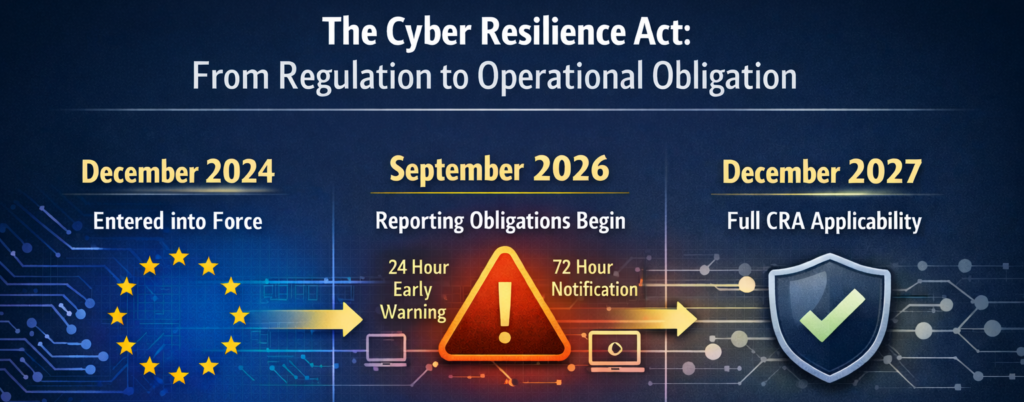
The Cyber Resilience Act establishes cybersecurity requirements as a condition for placing products with digital elements on the European market, with phased obligations beginning in 2026.
Compliance will depend less on written policies and more on the ability to understand product risk, manage vulnerabilities, and demonstrate continuous oversight across the product lifecycle. The organizations preparing now are not responding to a distant deadline. They are aligning governance, engineering, and security capabilities with a regulatory model that treats cybersecurity as an ongoing product responsibility.
The Cyber Resilience Act marks a structural change in how products are regulated within the European Union. Cybersecurity is no longer treated as a supporting function or post release activity. It becomes a core product obligation tied to EU market access and embedded within the EU conformity assessment framework.
For manufacturers, this represents a shift comparable to earlier safety and quality regulations. Products with digital elements must demonstrate that cybersecurity risks are understood, managed, and maintained throughout their supported lifecycle.
Although the main CRA obligations apply from December 11, 2027, certain operational requirements begin earlier. Organizations that treat the CRA as a distant deadline risk discovering too late that compliance depends on capabilities that require time to build and mature.
The timeline is already driving change.
The CRA applies broadly to products with digital elements, including connected equipment, embedded systems, and software enabled products.
Manufacturers must demonstrate cybersecurity from design through post market operation. This includes secure development practices, structured risk management, vulnerability handling processes, delivery of security updates during the support period, and maintenance of technical documentation demonstrating conformity with essential cybersecurity requirements.
Cybersecurity becomes measurable, repeatable, and auditable. It is no longer sufficient to show that activities occur. Manufacturers must be able to demonstrate traceable reasoning and documented decision making.
The CRA entered into force on December 10, 2024, with phased implementation.
Three dates should already be shaping manufacturer planning:
June 11, 2026. The framework related to conformity assessment bodies becomes applicable.
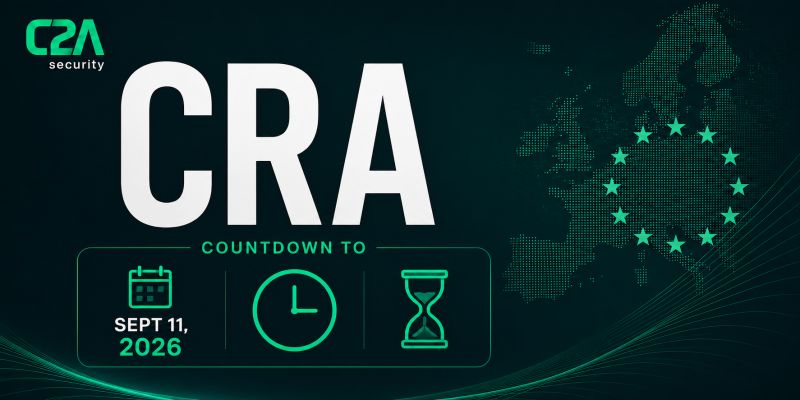
September 11, 2026. Mandatory reporting obligations begin for actively exploited vulnerabilities and severe incidents having an impact on product security.
December 11, 2027. The main CRA obligations apply to products placed on the EU market.
The September 2026 milestone is operational rather than procedural. Manufacturers must submit early warnings and follow up notifications within defined timelines once they become aware of actively exploited vulnerabilities or severe incidents.
This capability cannot be introduced late in the process.
Most manufacturers already perform elements of cybersecurity. Engineering teams conduct risk assessments. Security teams monitor vulnerabilities. Compliance teams maintain documentation. Suppliers provide component level information.
The challenge is fragmentation.
Information exists across multiple organizations and tools without a unified operational view. When a vulnerability emerges, manufacturers must quickly understand exposure across products, suppliers, and lifecycle stages.
Key questions must be answered rapidly:
Which products are affected
Where the vulnerable component is used
What mitigations already exist
Whether reporting thresholds are met
What documentation supports the decision
Without integrated context, these answers often require manual coordination across teams. Regulatory timelines reduce tolerance for fragmented processes.
CRA obligations emphasize accountability. Manufacturers must demonstrate not only that security activities occur, but that decisions are based on a clear understanding of product risk.
Context connects cybersecurity information to product architecture, deployment status, supplier contribution, and release state. It allows organizations to evaluate vulnerabilities based on real exposure rather than theoretical severity scores alone.
This becomes critical during incident reporting and conformity activities, where traceable reasoning and structured evidence are required.
Context transforms isolated security data into operational understanding.
As product complexity increases, cybersecurity decisions must remain consistent across programs and teams.
Security intelligence emerges when vulnerability data, component inventories, supplier inputs, and risk assessments are analyzed together. This enables prioritization based on measurable product impact rather than urgency alone.
Consistent decision making reduces regulatory risk and operational disruption. It also demonstrates that cybersecurity governance is systematic rather than reactive.
The CRA pushes organizations toward this level of maturity.
Modern products contain extensive software ecosystems. Vulnerability disclosures occur continuously and often affect shared components across multiple product lines.
Manual analysis does not scale under these conditions.
AI can support cybersecurity governance by correlating vulnerability intelligence with product structures, identifying affected systems, and assisting teams in prioritizing response actions based on contextual risk.
The objective is not automation of responsibility, but acceleration of analysis while maintaining human oversight and accountability.
This supports the operational speed and traceability required for CRA reporting obligations beginning in 2026.
CRA readiness requires more than vulnerability scanning. It requires contextual product intelligence.
C2A Security helps manufacturers operationalize product security governance across the lifecycle by connecting vulnerabilities, components, suppliers, and releases into a unified contextual view. This enables teams to evaluate risk based on actual product exposure and release state, while maintaining structured, audit ready evidence.
With C2A, organizations can strengthen capabilities that directly support CRA execution:
Real time visibility into cybersecurity posture across products and releases
Faster impact analysis when exploited vulnerabilities emerge
Traceable decision logic and evidence packaging to support reporting and conformity activities
Scalable governance across multi product portfolios and supplier ecosystems
Achieving CRA readiness involves coordination across engineering, product management, cybersecurity, and supply chain organizations. Processes must operate reliably before regulatory obligations take effect.
Manufacturers that begin early can integrate cybersecurity governance into ongoing product development. Those that delay may face the need to retrofit processes into active programs, increasing cost and complexity.
The phased timeline reflects the reality that organizational change requires time.
The Cyber Resilience Act establishes cybersecurity as a permanent component of product responsibility within the European market. The first operational obligations begin in 2026, not 2027.
Manufacturers should use the current period to establish contextual visibility, strengthen cybersecurity intelligence, and implement scalable processes capable of supporting regulatory reporting and conformity activity.
Cybersecurity under the CRA is no longer an aspirational objective but a demonstrable product obligation. Organizations that operationalize it early will be best positioned to meet regulatory expectations and market demands.
Reporting obligations begin on September 11, 2026. The organizations that succeed will not be those drafting policies in late 2027, but those building operational, evidence based cybersecurity governance now.
If you are preparing for CRA readiness and need to operationalize contextual risk visibility, vulnerability prioritization, and defensible evidence across your product portfolio, C2A Security can help.
Contact us to schedule a CRA readiness discussion and evaluate your current operational posture before reporting obligations begin.




Dynamic threat modeling and risk assessment aligned with global regulations
LLM-agnostic generative AI layer powering automation across every module
Aggregated threat feed contextualized against your actual products
Generate, manage, and triage all BOMs and vulnerabilities across the lifecycle
Quantitative optimization of mitigation strategy and security control allocation
Configurable dashboards and reports across every EVSec data layer
Extract software composition and risk from firmware and binaries without source code
Optimized anomaly detection for Ethernet and CAN, plus ECU runtime protection
Quantify and manage cybersecurity risk for products operating in the field
Enrich SOC events with deep product and architecture context
Context-driven test and validation with intelligent fuzzing, integrated into CI/CD
AI-powered static analysis integrated into CI/CD with reduced false positives
Foundational layer: cyber model, workspaces, and integration backbone to DevOps toolchain
Out-of-the-box and customizable workflows for regulatory and security processes
Centralized compliance management with evidence generated from live data