" " indicates required fields
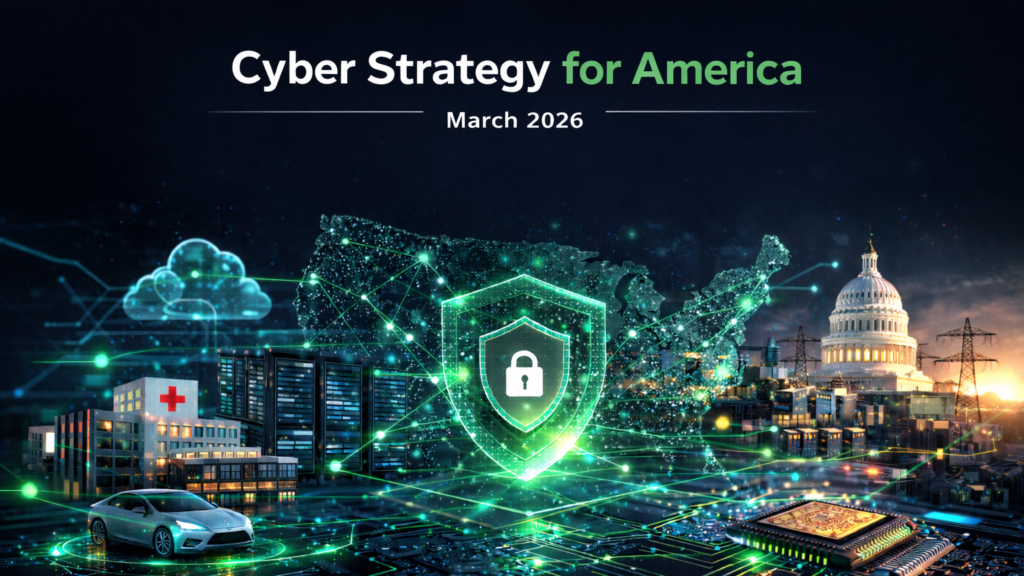
March 2026
To understand why the newly released Cyber Strategy for America matters, it helps to understand how U.S. cybersecurity policy evolved over the past decade.
For much of the last twenty years, cybersecurity policy has largely been reactive. Major incidents such as the Office of Personnel Management breach in 2015, the SolarWinds supply chain compromise in 2020, and repeated ransomware attacks against hospitals, utilities, and public institutions exposed how quickly adversaries could exploit weaknesses across interconnected systems.
Successive administrations introduced strategies, executive orders, and frameworks designed to improve resilience. Many of these efforts helped advance cybersecurity maturity, but implementation often proved uneven. Compliance frameworks expanded, sometimes creating a checklist mentality that increased administrative burden without always improving real security outcomes. Critical infrastructure operators frequently faced overlapping guidance from multiple regulatory bodies while adversaries continued to expand their capabilities.
At the same time, nation state actors continued to develop sophisticated cyber operations targeting supply chains, infrastructure, and intellectual property.
The central challenge has remained consistent. How do governments and organizations secure a complex digital economy while preserving the innovation and speed that drive technological progress?
The new U.S. cyber strategy attempts to address that challenge directly.
Released in March 2026, the latest U.S. cyber strategy reflects the growing recognition that cyberspace is now a core domain of economic and national security competition. Threat actors increasingly target not only government networks but also the commercial infrastructure that supports daily life, including healthcare systems, energy networks, financial services, and cloud infrastructure.
Rather than focusing primarily on compliance structures, the strategy emphasizes operational resilience, stronger public private collaboration, and proactive defense against adversaries.
The framework is organized around six policy pillars.
The strategy places greater emphasis on disrupting adversary infrastructure before attacks occur. This includes coordinated use of defensive and offensive cyber capabilities, intelligence sharing with the private sector, and broader diplomatic and economic tools designed to raise the cost of malicious cyber activity.
Cybercrime and intellectual property theft are highlighted as major threats to global economic stability.
A key theme of the strategy is simplifying cybersecurity regulation while improving actual security outcomes. The goal is to reduce fragmented compliance requirements and allow organizations to focus on measurable resilience rather than paperwork.
For industry, this could mean fewer overlapping frameworks but greater expectation for demonstrable security practices.
The federal government plans to accelerate adoption of zero trust architecture, post quantum cryptography, and secure cloud infrastructure. AI driven security tools are expected to play a larger role in defending government systems and improving threat detection.
Procurement reforms are also intended to make it easier for innovative security vendors to work with federal agencies.
Protecting critical infrastructure remains a central focus. The strategy highlights sectors such as energy, telecommunications, healthcare, transportation, and financial systems.
Organizations operating in these sectors should expect closer collaboration with federal agencies along with increased scrutiny of supply chain security and technology sourcing.
Artificial intelligence, quantum computing, and advanced cryptography are recognized as technologies that will shape the future cyber landscape.
The strategy emphasizes securing the full AI technology stack, deploying AI enabled defense capabilities, and promoting international cooperation to ensure emerging technologies are developed responsibly.
Cybersecurity talent remains a critical constraint. The strategy calls for expanded education programs, vocational training pathways, and closer collaboration between academia, government, and industry to grow the cybersecurity workforce.
Developing sustainable talent pipelines is seen as essential to long term cyber resilience.
National cyber strategies are only meaningful if they influence real operational change. Several practical implications are already clear for organizations across sectors.
More proactive cyber defense
The strategy signals stronger collaboration between government and industry in identifying and disrupting malicious infrastructure earlier in the attack lifecycle.
Less focus on compliance checklists
While regulations may become more streamlined, expectations for measurable security maturity are likely to increase.
Zero trust and cryptographic modernization
Federal adoption of zero trust and post quantum cryptography will likely influence requirements across government contractors and supply chains.
AI security becomes critical
As organizations deploy AI systems, attackers will increasingly target models, training pipelines, and data infrastructure.
Supply chain visibility is essential
Recent supply chain compromises demonstrated that vulnerabilities often originate deep within software dependencies and vendor ecosystems.
Cyber talent remains scarce
Organizations that invest in training, automation, and security orchestration will be better positioned to operate effectively with limited personnel.
Cybersecurity is shifting from reactive incident response toward continuous operational resilience.
The new U.S. cyber strategy reinforces several trends already underway: deeper public private collaboration, stronger protection of critical infrastructure, and greater attention to securing emerging technologies and complex supply chains.
Organizations that treat cybersecurity as a strategic capability rather than a compliance exercise will be best positioned to operate in this evolving environment.
C2A Security helps organizations operationalize product security and supply chain risk management across complex connected systems.
Our EVSec platform enables security teams to move beyond static vulnerability lists and instead understand risk in the context of how software components are actually used across products and environments.
C2A helps organizations:
Operationalize SBOM intelligence
Continuously ingest and analyze SBOM data to identify vulnerabilities across software supply chains and prioritize remediation based on real exposure.
Understand contextual product risk
Correlate vulnerabilities, configurations, and system architecture to determine which issues truly impact operational environments.
Support regulatory and security frameworks
Map security activities to emerging regulatory requirements and industry standards without relying on fragmented manual processes.
Secure complex connected systems
Provide visibility across modern product ecosystems that combine software, embedded systems, cloud infrastructure, and operational technology.
By turning vulnerability data into actionable security decisions, C2A enables organizations to strengthen resilience while reducing the operational burden on security teams.





Dynamic threat modeling and risk assessment aligned with global regulations
LLM-agnostic generative AI layer powering automation across every module
Aggregated threat feed contextualized against your actual products
Generate, manage, and triage all BOMs and vulnerabilities across the lifecycle
Quantitative optimization of mitigation strategy and security control allocation
Configurable dashboards and reports across every EVSec data layer
Extract software composition and risk from firmware and binaries without source code
Optimized anomaly detection for Ethernet and CAN, plus ECU runtime protection
Quantify and manage cybersecurity risk for products operating in the field
Enrich SOC events with deep product and architecture context
Context-driven test and validation with intelligent fuzzing, integrated into CI/CD
AI-powered static analysis integrated into CI/CD with reduced false positives
Foundational layer: cyber model, workspaces, and integration backbone to DevOps toolchain
Out-of-the-box and customizable workflows for regulatory and security processes
Centralized compliance management with evidence generated from live data