" " indicates required fields
C2A Security · July 2026 · 10 min read
Cybersecurity is no longer measured solely by an organization’s ability to prevent vulnerabilities. Increasingly, regulators, customers, and the security community expect manufacturers to demonstrate how effectively they identify, receive, prioritize, remediate, and disclose vulnerabilities throughout the product lifecycle.
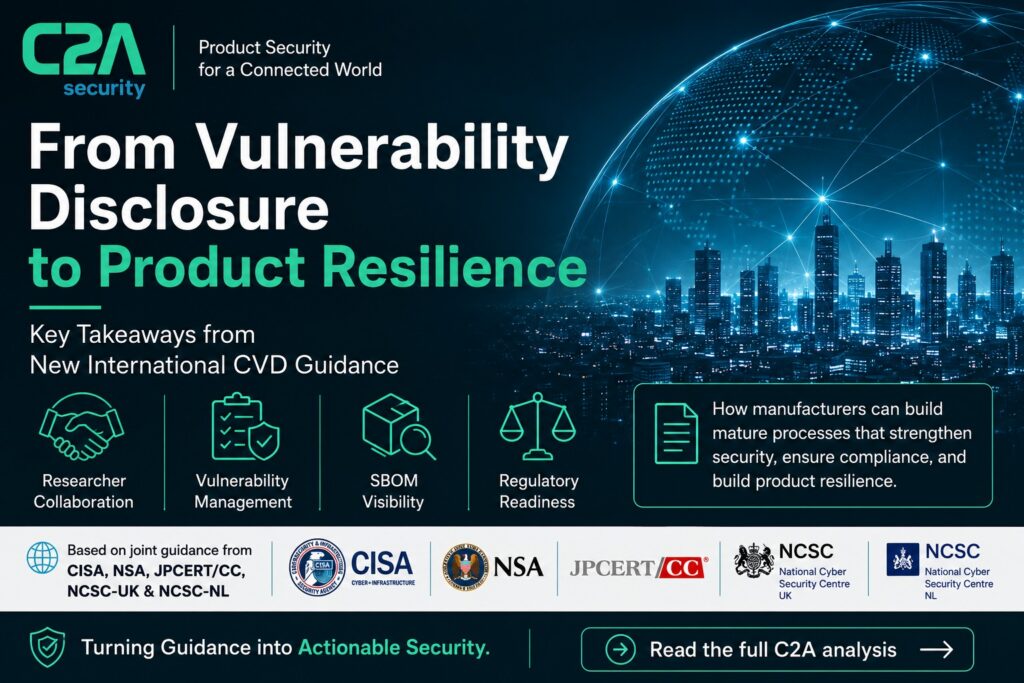
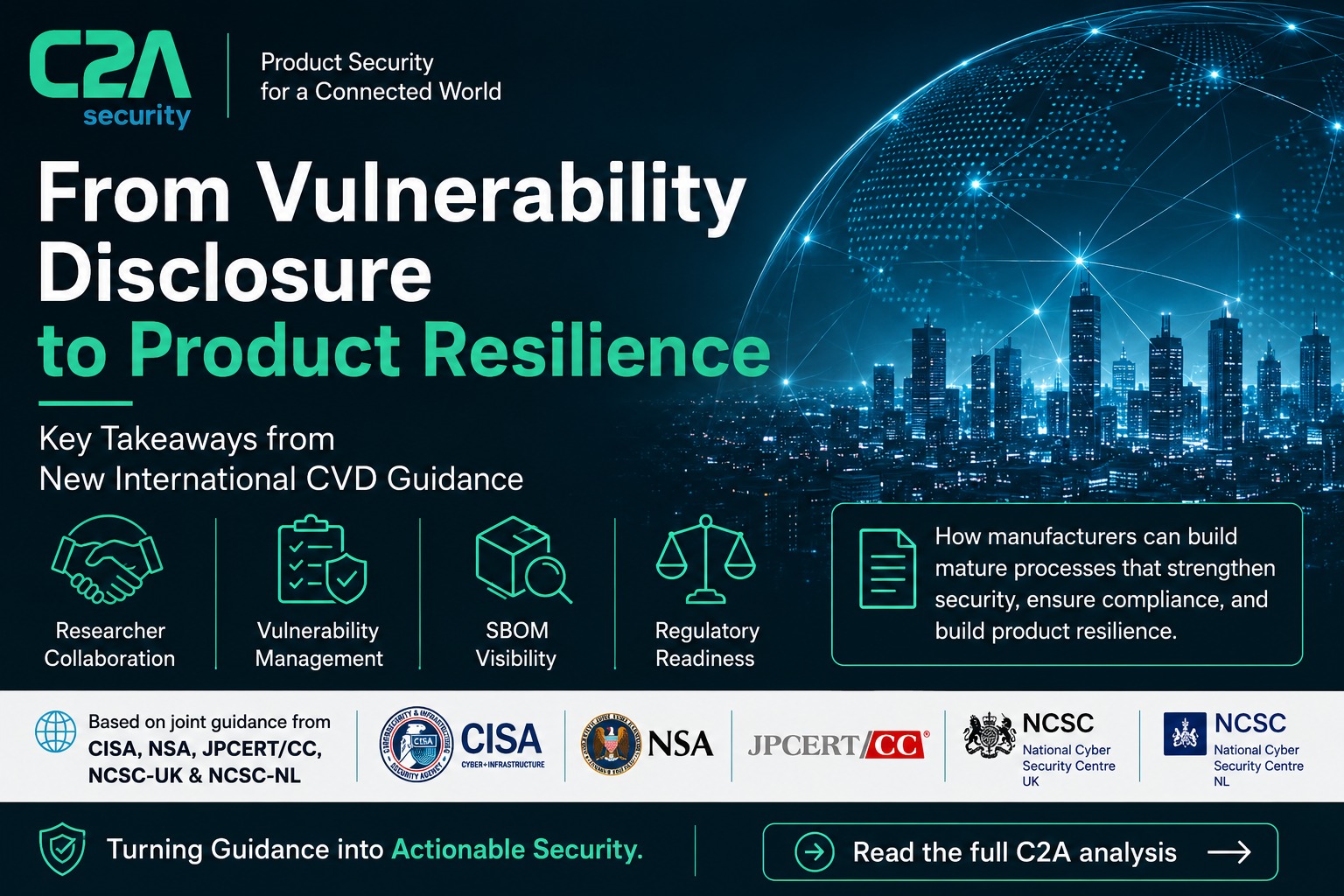
The recently published “Establishing a Coordinated Vulnerability Disclosure Program to Work With Security Researchers”, jointly authored by the U.S. Cybersecurity and Infrastructure Security Agency (CISA), the National Security Agency (NSA), Japan’s JPCERT/CC, the UK’s National Cyber Security Centre (NCSC-UK), and the Netherlands’ National Cyber Security Centre (NCSC-NL), provides perhaps the clearest blueprint yet for building a mature Coordinated Vulnerability Disclosure (CVD) program.
Although the document focuses on vulnerability disclosure, its implications extend much further. It reinforces a global shift toward structured Product Security Incident Response Teams (PSIRTs), continuous vulnerability management, transparency, and lifecycle governance—capabilities that are becoming essential for manufacturers of software-defined vehicles, medical devices, industrial control systems, IoT devices, robotics, and other connected products.
In this article, we’ll examine what the guidance means, why it matters, and how manufacturers can begin building the operational capabilities needed to meet both today’s security expectations and tomorrow’s regulatory requirements.
For years, vulnerability disclosure programs were viewed as a best practice adopted primarily by large technology companies.
That is no longer the case.
The joint guidance makes it clear that organizations developing connected products should establish formal processes that enable security researchers to report vulnerabilities responsibly while allowing manufacturers to investigate, prioritize, remediate, and publicly disclose those findings in a coordinated manner.
This is more than a recommendation about publishing a contact email or creating a security policy. It represents an evolution in how product security is managed.
Security researchers are no longer viewed as outsiders who occasionally discover software bugs. They have become valuable contributors to the broader cybersecurity ecosystem, helping manufacturers discover vulnerabilities before malicious actors can exploit them.
Organizations that embrace this collaborative model improve not only their security posture but also customer confidence, operational resilience, and regulatory readiness.
Perhaps most importantly, this guidance reflects growing international alignment around product cybersecurity. It is authored not by a single government agency but by leading cybersecurity organizations from the United States, United Kingdom, Japan, and the Netherlands, demonstrating a shared global vision for coordinated vulnerability management.
One of the report’s strongest messages is that a mature Coordinated Vulnerability Disclosure program is not simply a way to receive vulnerability reports.
Instead, it is an operational capability that spans the entire vulnerability lifecycle.
An effective CVD program integrates multiple disciplines, including:
Each of these capabilities contributes to a structured process that enables organizations to respond consistently, transparently, and efficiently whenever vulnerabilities are discovered.
While policies define the rules of engagement, organizations also need technology to operationalize these processes. Modern product security platforms connect vulnerability reports, Software Bills of Materials (SBOMs), engineering workflows, compliance evidence, and remediation activities into a unified view, replacing manual spreadsheets and disconnected tools with continuous, risk-driven vulnerability management.
Learn more about the C2A Security Product Security Platform: Platform | C2A Security – The Only Risk-Driven DevSecOps Platform
The guidance outlines numerous best practices, but five themes consistently emerge as the foundation of an effective Coordinated Vulnerability Disclosure program.
1. Publish a Clear Vulnerability Disclosure Policy
Every successful CVD program begins with a publicly available Vulnerability Disclosure Policy (VDP).
The policy should clearly explain:
The report also recommends implementing a security.txt file, allowing researchers to quickly locate reporting instructions through a standardized mechanism.
A well-written VDP reduces uncertainty for researchers while helping organizations establish consistent internal processes.
2. Build Trust With Security Researchers
One of the most refreshing aspects of the guidance is its emphasis on collaboration.
Rather than treating security researchers as potential adversaries, organizations should actively encourage responsible disclosure and establish clear expectations that foster trust.
Among the report’s strongest recommendations is the inclusion of safe harbor language, assuring researchers that good-faith security research conducted within the published policy will not expose them to unnecessary legal action.
This seemingly simple policy decision has significant implications.
Researchers are far more likely to disclose vulnerabilities responsibly when organizations demonstrate transparency, responsiveness, and respect for responsible security research.
The report also encourages organizations to avoid practices that discourage disclosure, including overly restrictive agreements or silent fixes that leave customers unaware of previously identified vulnerabilities.
3. Establish Structured Triage and Remediation
Receiving vulnerability reports is only the beginning.
Organizations must also develop repeatable workflows that acknowledge reports quickly, validate findings, assess severity, prioritize remediation, communicate progress, verify fixes, and coordinate disclosure.
The guidance recommends acknowledging researcher submissions within a defined timeframe and maintaining regular communication throughout the remediation process. It also recommends separating vulnerability reporting from traditional customer support channels to ensure reports receive appropriate attention.
These recommendations reflect an important principle:
Vulnerability management should operate as a dedicated business process rather than an extension of customer support.
Modern vulnerability management platforms further enhance this process by helping organizations understand not only which vulnerabilities exist, but which vulnerabilities actually matter.
We’ll explore that concept in the next section.
4. Prioritize Risk, Not Just Vulnerabilities
One of the biggest challenges facing security teams today is not discovering vulnerabilities—it’s determining which ones deserve immediate attention.
Thousands of new Common Vulnerabilities and Exposures (CVEs) are published every year. While each represents a documented security weakness, only a fraction pose meaningful risk to a specific product or deployment.
Without context, organizations often spend valuable engineering resources patching vulnerabilities that have little or no operational impact, while more significant risks remain unresolved.
The CISA guidance recommends establishing structured processes for triage, risk assessment, and remediation, including leveraging decision-support frameworks such as Stakeholder-Specific Vulnerability Categorization (SSVC) to prioritize remediation activities.
For manufacturers of connected products, effective prioritization requires answering questions such as:
Answering these questions requires more than vulnerability scanners. It requires visibility into the complete software supply chain.
Modern product security platforms provide that context, helping organizations prioritize vulnerabilities based on actual product risk rather than simply CVSS scores.
Organizations looking to mature their vulnerability operations can learn more about C2A Security’s Vulnerability Management capabilities: https://c2a-sec.com/use-cases/vulnerability-management/
5. Maintain Software Visibility Through SBOMs
A mature Coordinated Vulnerability Disclosure program depends on understanding where vulnerable software components exist across your products. That visibility comes from maintaining accurate, continuously updated Software Bills of Materials (SBOMs).
Another implication of the guidance is the growing importance of Software Bills of Materials (SBOMs).
Although SBOMs are often discussed as compliance artifacts, their true value lies in operational security.
Whenever a new vulnerability is disclosed, organizations must quickly determine:
Without an accurate and continuously maintained SBOM, answering these questions can take days—or even weeks.
With a living SBOM integrated into product security workflows, manufacturers can rapidly identify affected products, prioritize remediation, and communicate accurately with customers.
This capability has become increasingly important as regulations such as the EU Cyber Resilience Act place greater emphasis on software transparency and lifecycle security.
Learn more about SBOM Creation and Management: https://c2a-sec.com/use-cases/sbom-creation-and-management/
Successfully fixing a vulnerability is only one step in the disclosure process.
The guidance places considerable emphasis on maintaining accurate CVE records, publishing timely security advisories, communicating remediation guidance, and recognizing the contributions of responsible security researchers where appropriate.
It also encourages organizations to establish repeatable communications processes that include:
This reflects an important shift.
Transparency is becoming a competitive advantage.
Organizations that communicate clearly and consistently during vulnerability response strengthen customer confidence while demonstrating mature cybersecurity governance.
Perhaps the most significant aspect of the guidance is its explicit connection to regulation.
The report notes that the EU Cyber Resilience Act (CRA) requires suppliers operating within the European Union to establish vulnerability handling and disclosure processes as part of their cybersecurity responsibilities.
For manufacturers, this reinforces an important message:
Coordinated Vulnerability Disclosure is rapidly evolving from a recommended best practice into a regulatory expectation.
Organizations that wait until regulations take effect may find themselves building entirely new operational capabilities under significant time pressure.
Forward-looking manufacturers are already investing in:
Manufacturers preparing for the CRA can learn more about C2A Security’s approach to Industrial & IoT Cyber Resilience Act readiness: Industrial & IoT | C2A Security – The Only Risk-Driven DevSecOps Platform
Creating a Vulnerability Disclosure Policy is an important first step.
Operationalizing it is where the real work begins.
Organizations must integrate vulnerability disclosure into broader product security operations spanning development, testing, release, deployment, post-market monitoring, compliance, and customer communications.
This requires end-to-end traceability.
Every security requirement, software component, vulnerability, engineering task, remediation decision, validation activity, and regulatory obligation should remain connected throughout the product lifecycle.
This level of traceability enables organizations not only to respond more efficiently to vulnerabilities but also to demonstrate compliance during audits and regulatory reviews.
C2A Security’s Design-to-Postmarket Traceability approach provides manufacturers with continuous visibility across the entire software lifecycle, helping engineering, security, quality, and compliance teams work from a common operational picture.
Learn more: Design to Postmarket Traceability | C2A Security – The Only Risk-Driven DevSecOps Platform
The new international guidance represents far more than recommendations for working with security researchers.
It reflects the industry’s broader evolution toward continuous product cybersecurity governance.
Manufacturers are increasingly expected to demonstrate that they can:
Organizations that build these capabilities today will be better positioned to satisfy customers, regulators, and the evolving cybersecurity landscape.
For many manufacturers, Coordinated Vulnerability Disclosure is no longer simply part of product security.
It is becoming one of its defining capabilities.
Whether your organization is establishing its first Coordinated Vulnerability Disclosure program, strengthening an existing PSIRT, preparing for the Cyber Resilience Act, or improving vulnerability management across connected products, the underlying objective remains the same: building resilient products that customers can trust.
At C2A Security, we help manufacturers operationalize product cybersecurity through continuous visibility, contextual vulnerability management, lifecycle traceability, SBOM management, regulatory readiness, and risk-based governance.
Schedule a demo of the C2A EVSec Platform here: Schedule a Demo | C2A Security – The Only Risk-Driven DevSecOps Platform
For readers interested in exploring the original publication, the complete guidance is available from CISA and its international partners:





Dynamic threat modeling and risk assessment aligned with global regulations
LLM-agnostic generative AI layer powering automation across every module
Aggregated threat feed contextualized against your actual products
Generate, manage, and triage all BOMs and vulnerabilities across the lifecycle
Quantitative optimization of mitigation strategy and security control allocation
Configurable dashboards and reports across every EVSec data layer
Extract software composition and risk from firmware and binaries without source code
Optimized anomaly detection for Ethernet and CAN, plus ECU runtime protection
Quantify and manage cybersecurity risk for products operating in the field
Enrich SOC events with deep product and architecture context
Context-driven test and validation with intelligent fuzzing, integrated into CI/CD
AI-powered static analysis integrated into CI/CD with reduced false positives
Foundational layer: cyber model, workspaces, and integration backbone to DevOps toolchain
Out-of-the-box and customizable workflows for regulatory and security processes
Centralized compliance management with evidence generated from live data